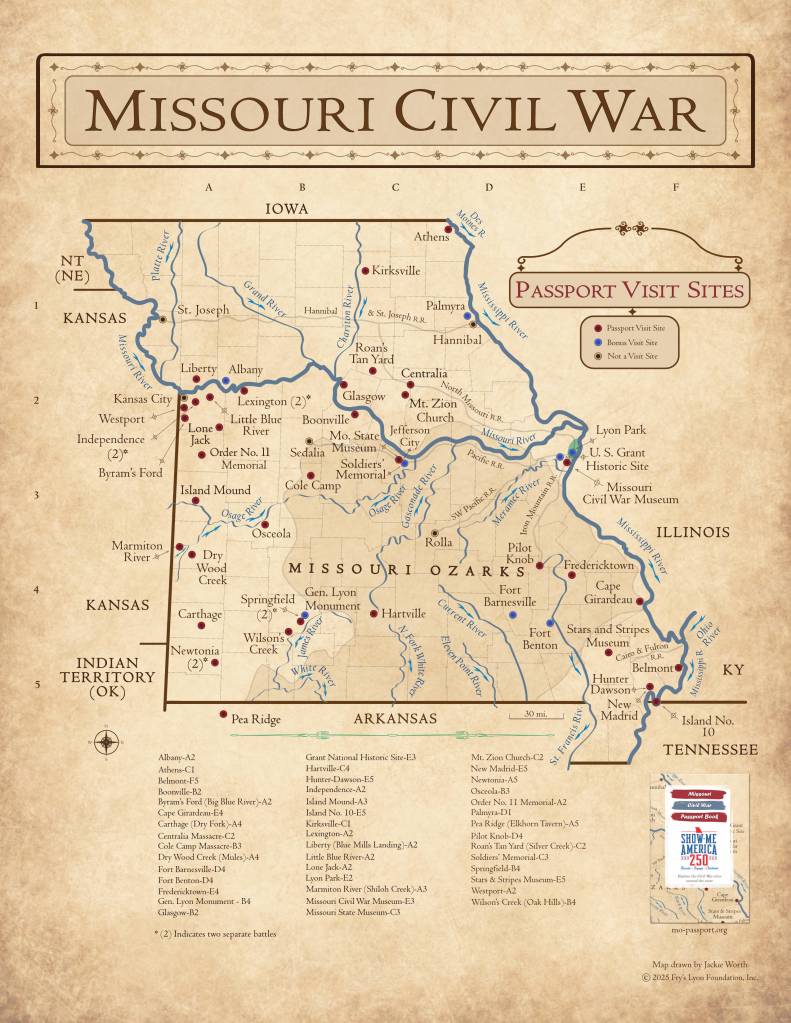
Participants who visit these “Bonus Visit Sites” in addition to the other sites in this book will earn a large antique-style map of all the visit sites, along with their certificate. See map at the bottom of this page. (You must purchase the new “Show-Me America 250” edition of the Passport Book to to record your visits to the Bonus Sites.) See How to Get Your Certification of Completion for details.
If you’ve visited a Civil War-related site in (or near) Missouri that is a “must-see,” let us know!
1. Soldiers’ Memorial Plaza at Lincoln University, Jefferson City, Missouri
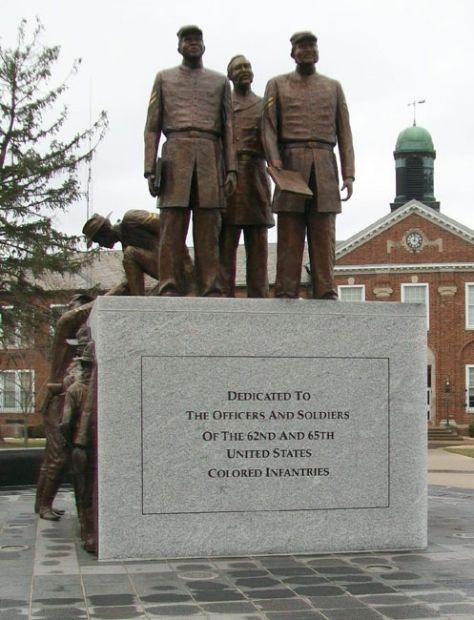
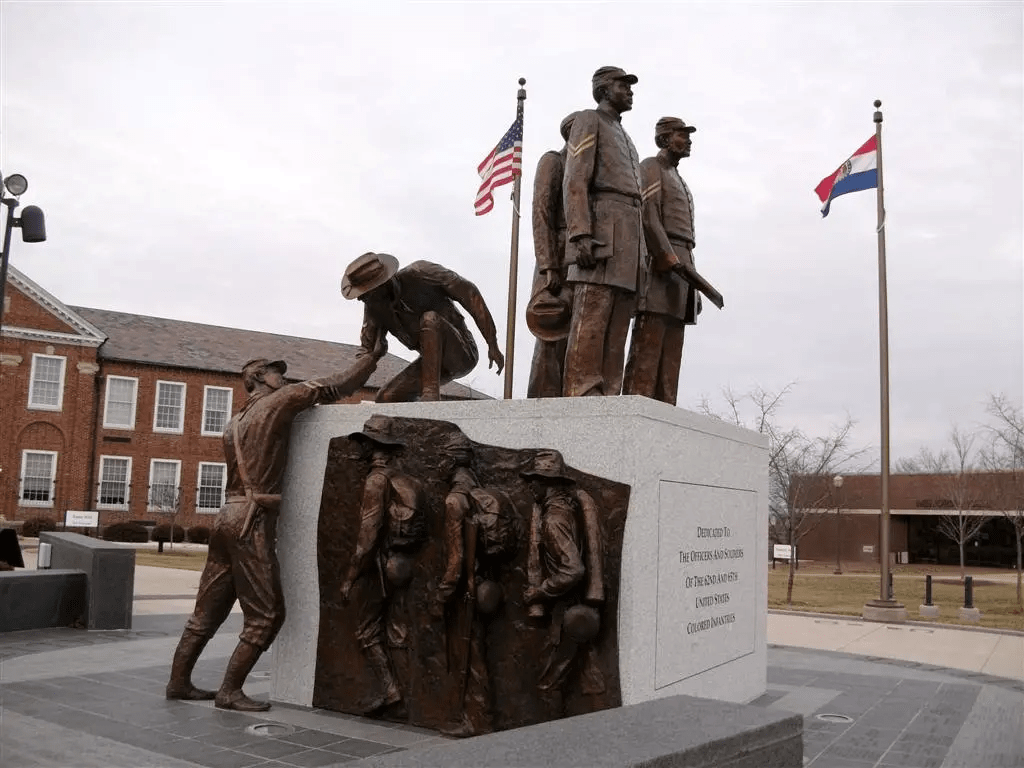
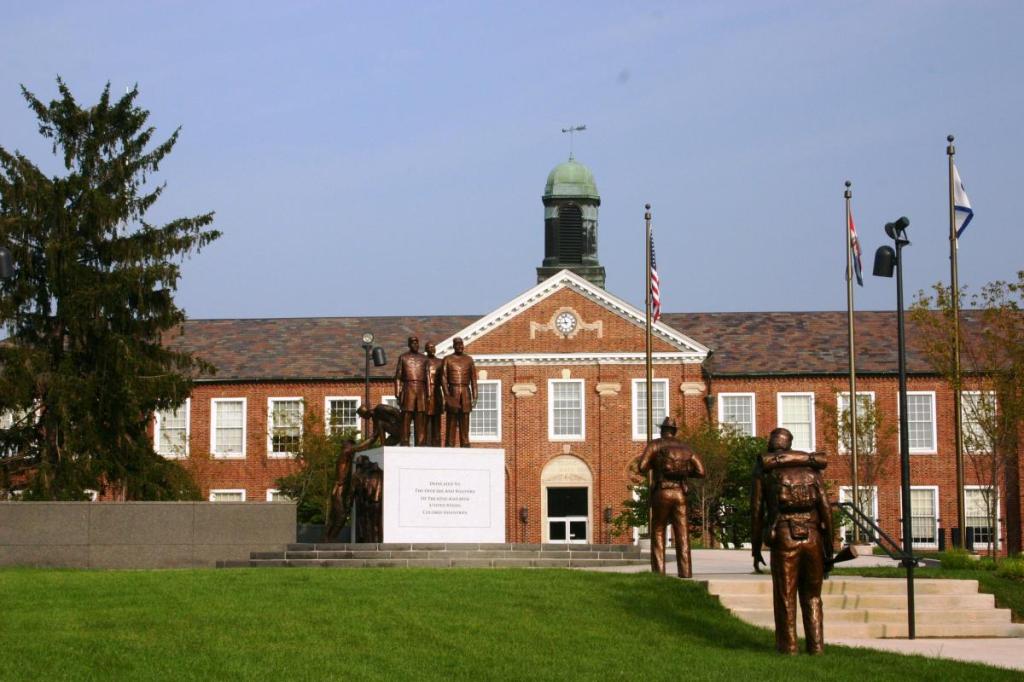
To commemorate one of the most significant and selfless acts of empowerment, inspiration and commitment to higher education in history, Lincoln University developed, constructed and dedicated the Lincoln University Solder’s Memorial Plaza. This monument serves as a permanent tribute to the Lincoln University founders–the brave and benevolent men of the 62nd and 65th Colored Infantries who served gallantly in the U.S. Civil War. Near the end of the Civil War, this dedicated and progressive-minded group of soldiers who served as “camp laborers” for union troops recognized the need for formal education and raised nearly $6,400.00 for a school in their home state of Missouri. The soldiers ignored racial divisions and boundaries and combined their resources to secure the initial funds for what was then known as Lincoln Institute. The presence of this memorial centerpiece on campus provides an opportunity for Lincoln University students, alumni, faculty and friends to gather together in support and unity and also to encourage thoughtful discussions of how we can work together to further promote the mission and vision of the University. [Source: https://www.visitjeffersoncity.com/listing/soldiers-memorial-plaza-at-lincoln-university/76/]
Address:
820 Chestnut St.
Jefferson City, MO 65101
Excellent close-up pictures of the memorial can be found at the blog “Civil War Medicine and Writing,” by Jim Schmidt, found at the following link: http://civilwarmed.blogspot.com/2014/05/courage-sacrifice-humanity-equality.html
Read about the history of Lincoln University: https://www.lincolnu.edu/about-lincoln/our-history.html

2. Ulysses S. Grant National Historic Site, St. Louis, Missouri
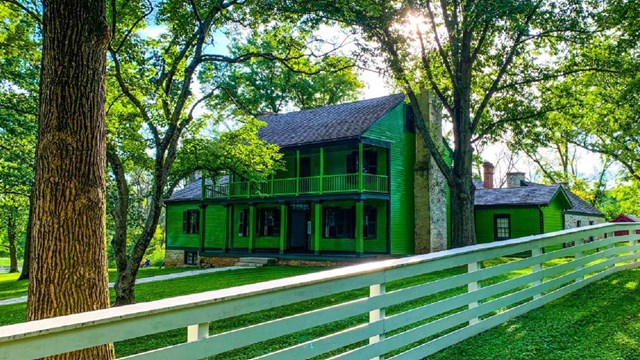
The site, also known as White Haven, commemorates the life, military career and presidency of Ulysses S. Grant. Five historic structures are preserved at the site, including the childhood home of Ulysses’ wife, Julia Dent Grant.
The National Park Service maintains about 10 acres of the original farm with White Haven. Much of the surrounding area is now a residential subdivision. Thankfully, a large portion of the original farmland came into the possession of the Busch family, who turned it into an animal reserve. Known as Grant’s Farm, the reserve is right across from the park site.
Grant’s Farm also preserves Hardscrabble, a cabin U.S. Grant built himself, which remains one of the last remaining buildings hand built by a president. U.S. Grant and Julia lived in this cabin briefly but moved back into White Haven following the death of Julia’s mother.
Hours: Daily 9:00 AM–5:00 PM (except major holidays)
[Source: https://wanderfilledlife.com/ulysses-s-grant-national-historic-site/; wikipedia]
Link: https://www.nps.gov/ulsg/index.htm
Link: https://www.facebook.com/USGrantNPS
Address:
7400 Grant Rd, St. Louis, Mo.
Hours: Daily 9:00 AM–5:00 PM (except major holidays)
3. Fort Benton, Patterson, Missouri
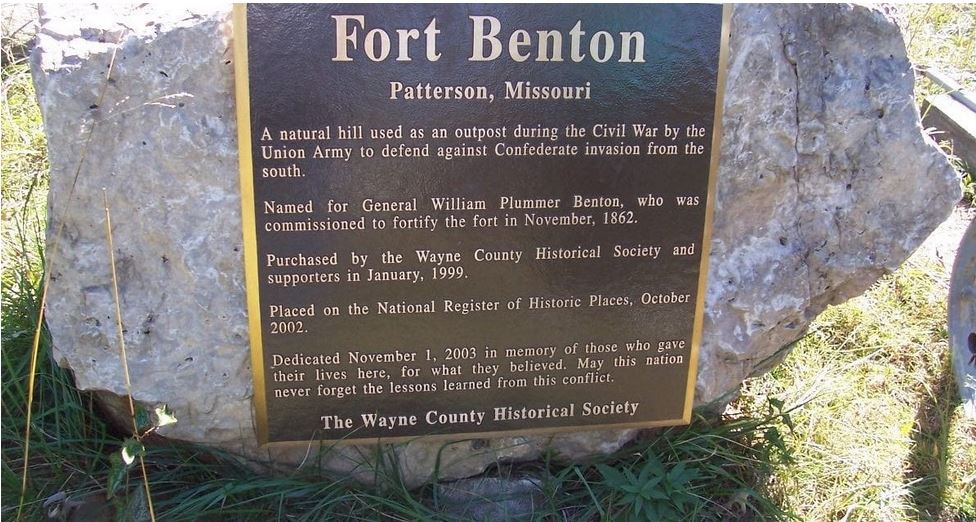
Fort Benton, also known as Fort Hill, is a historic American Civil War fortification located near Patterson, Wayne County, Missouri. Its earthen walls measure approximately 100 feet by 100 feet. The fortification supported an encampment of Union troops stationed at Patterson to secure the area against local Confederate guerillas. It was also one of a string of fortifications designed to protect Union Missouri from invasion from Confederate Arkansas.—Wikipedia
Fort Benton is located just south of Patterson town center on Hwy FF. Drive between the Patterson Community Center (the old Patterson school) on the right and the Patterson Cemetery on the left, going up the hill in the woods. Watch for Fort Benton sign.
Links:
Wayne County Historical Society/Fort Benton
4. The Battle of Albany Monument (William “Bloody Bill” Anderson Memorial), Orrick, Missouri
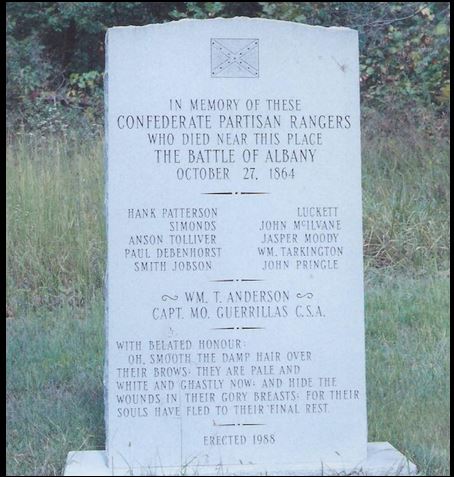
The Battle of Albany Monument is located at the battlefield near the present town of Orrick, Missouri and honors the eleven Missouri Partisan Rangers that died there. On October 26,1864, a company of Missouri Partisan Rangers CSA led by Captain William T. “Bill” Anderson were camped at this spot.
Links:
https://www.findagrave.com/memorial/65585966/battle_of-albany_monume
Additionally, the grave and tombstone of William “Bloody Bill” Anderson is at Pioneer Cemetery, Richmond, Missouri
https://www.findagrave.com/cemetery/640976/pioneer-cemeter
5. Fort Barnesville near Ellington, Missouri
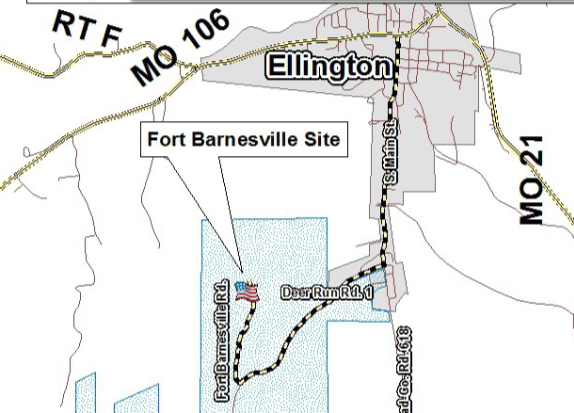
Fort Barnesville is classified as an earthen-type redan fort in a horseshoe shape with two cannon pads and a powder magazine. It was named Barnesville because of its proximity to the town of Barnesville, now Ellington.
Research showed the 13th Illinois Cavalry, which had helped with the construction of Fort Davidson, Fort Benton and at Bloomfield, camped at Barnesville during January through April, 1863. They are the likely builders of Fort Barnesville, possibly assisted by the 25th Missouri Infantry, known fort builders in the Corinth, Mississippi, area and present at the Barnesville location in early 1863. –Reynolds County Museum.
Link: Fort Barnesville
Map: http://wp.rcghs.org/wp-content/uploads/2020/08/map_fortbarnseville1.pdf
6. Palmyra Massacre Memorial and Marker, Palmyra, Missouri
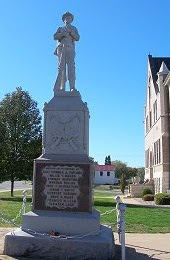
The Palmyra Massacre was the execution of ten Confederate prisoners as retribution for the capture of a pro-Union civilian, Andrew Allsman.
Links:
http://www.civilwarmo.org/educators/resources/info-sheets/palmyra-massacre
https://civil-war-picket.blogspot.com/2012/09/palmyra-massacre-missouri-community.html?m=0
Memorial Statue
Address:
100 South Main Street, Palmyra, MO 63461
Marker
There is also a marker outside the Old Marion County Jail Museum
Address:
200 W. Lafayette St., Palmyra, MO 63461
Museum Hours:
10 a.m. to 2 p.m. Wednesdays or by appointment
7. Lyon Park, St. Louis, Missouri
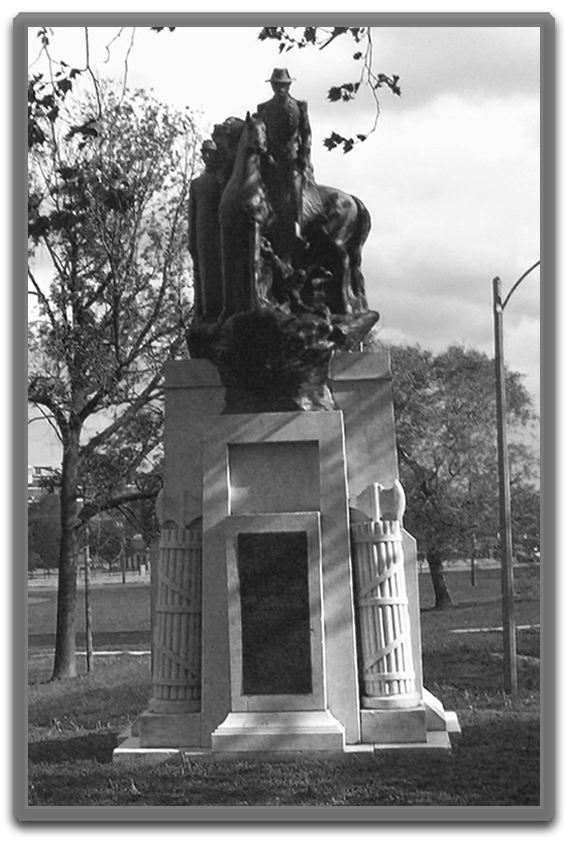
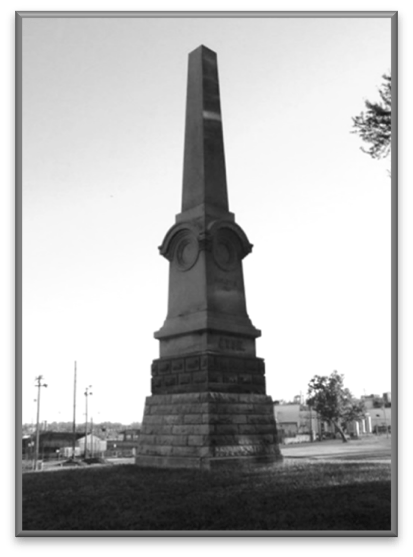
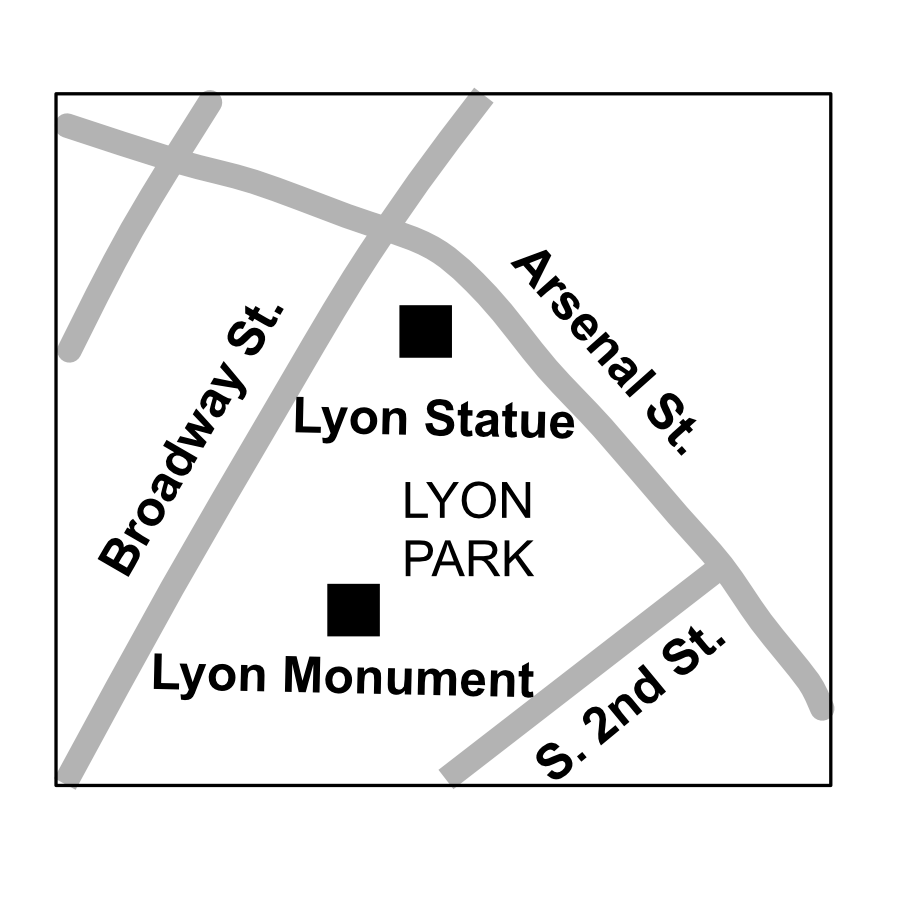
In March 1869, ten acres at the front of the St. Louis Arsenal grounds were given to the city of St. Louis for the erection of a monument to the late Brig. Gen. Nathaniel Lyon. The monument (right), dedicated on September 13, 1874, consists of a 28-foot obelisk of Missouri granite.
The Lyon Statue (left), erected by the Camp Jackson Union Soldiers Monument Association, commemorates the capture of Camp Jackson on May 10, 1861.
Address:
Arsenal St. & Broadway St.
8. Gen. Lyon Monument, Springfield, Missouri
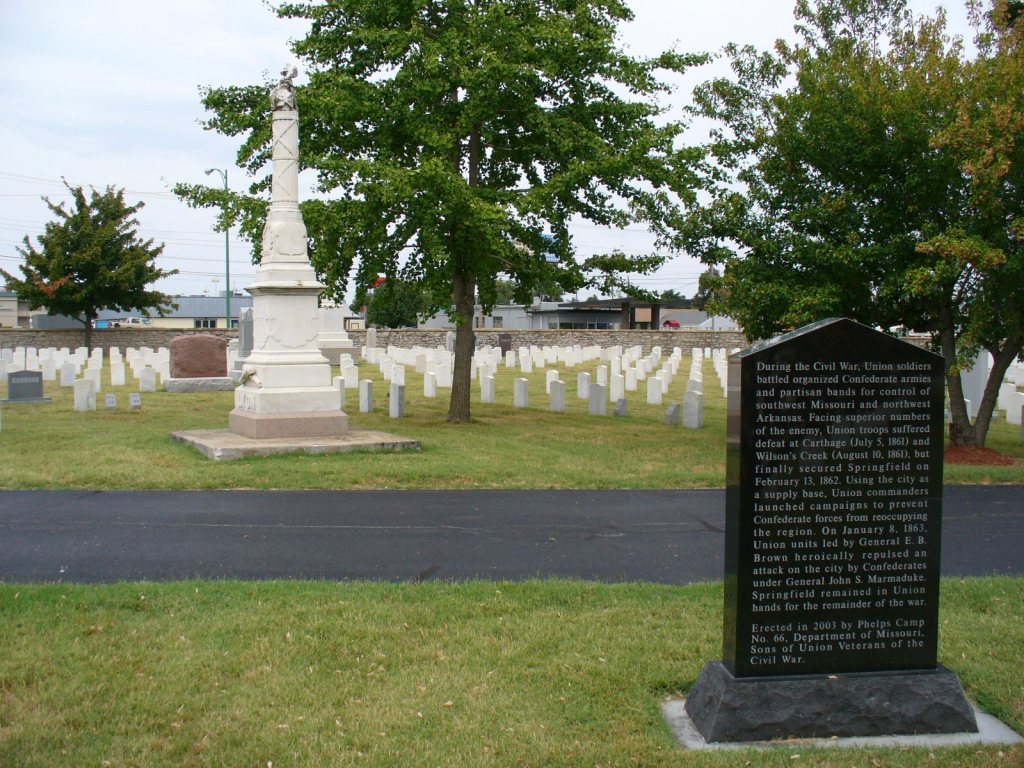
The City of Springfield purchased a monument to General Lyon that was dedicated during the first reunion of the veterans of the battle of Wilson’s Creek in 1883. It was initially located on the square but was eventually relocated adjacent to Gen. Lyon Boulevard in the Springfield National Cemetery. Across from the Lyon monument, stands a memorial for all Union soldiers who gave their lives in and around Springfield.
Address: Springfield National Cemetery, 1702 E Seminole St., Springfield, Mo.
If you visit these bonus sites as well as the other Passport Visit Sites, you will earn a 16 x 20 map of all the sites (shown below), as well a a Certificate of Completion.

You must be logged in to post a comment.